
Quick answer
A reliable disposable period underwear manufacturer should offer consistent product quality, verified absorbency and leakage protection, OEM/ODM customization, private label packaging, and documented quality control procedures. Overseas buyers should also evaluate certifications, minimum order quantities (MOQ), production lead times, sample quality, and export experience before choosing a long-term manufacturing partner.
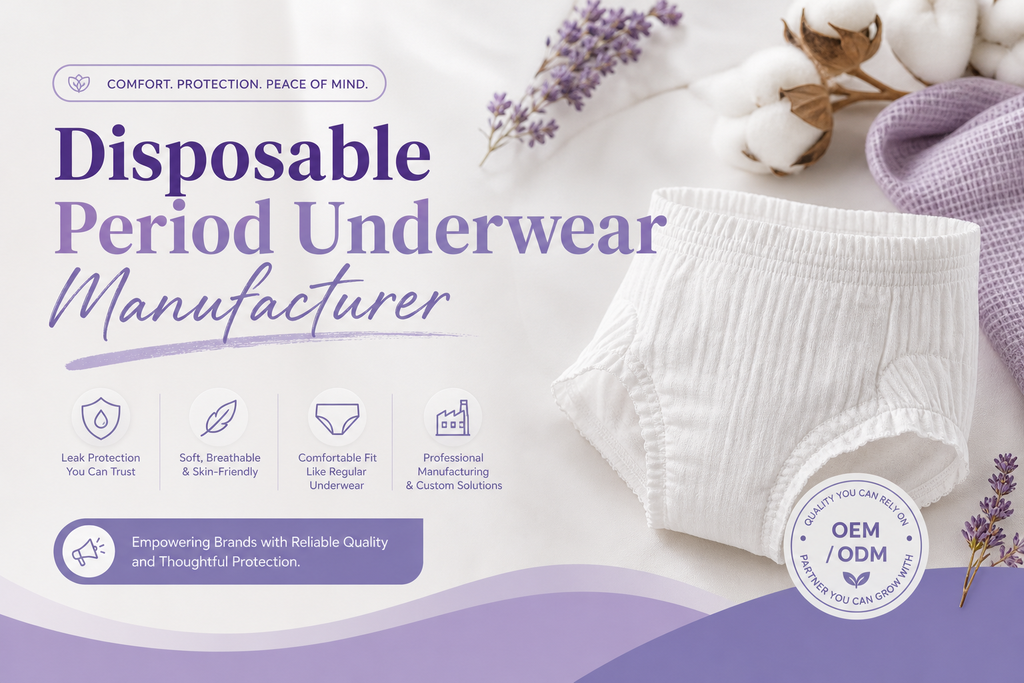
Finding the right disposable period underwear manufacturer is an important step for feminine care brands, private label companies, importers, and distributors looking to develop reliable menstrual hygiene products.
Unlike traditional sanitary pads, disposable period underwear combines an underwear-style design with integrated absorbent materials to provide full-coverage menstrual protection. This product structure requires careful consideration of absorbency, leakage protection, comfort, fit, and manufacturing consistency.
For businesses planning to launch or expand a disposable menstrual underwear product line, choosing a manufacturing partner involves more than comparing prices. Production capabilities, material selection, product customization, quality management, and international supply experience all play an important role in long-term cooperation.
An experienced disposable period underwear OEM manufacturer can help brands develop products that meet their target market’s requirements while supporting sampling, private label packaging, and scalable production.
In this guide, we explore the key factors B2B buyers should evaluate when selecting a disposable period underwear manufacturer, along with practical questions to ask before placing an order.
1. Understanding Disposable Period Underwear Manufacturing
Before evaluating suppliers, it is important to understand what makes disposable period underwear different from other menstrual care products.
What Is Disposable Period Underwear?
Disposable period underwear is a single-use menstrual hygiene product designed to be worn like regular underwear.
It typically incorporates an absorbent core, soft nonwoven materials, a leak-resistant outer layer, and an underwear-style structure to provide menstrual protection.
Unlike washable period underwear, disposable period underwear is intended for single use and disposal after wearing.
Depending on product specifications, disposable period underwear may be developed for:
Menstrual protection during daytime activities
Overnight menstrual protection
Heavy menstrual flow management
Travel and convenience
Consumers seeking full-coverage protection
Product suitability depends on the design, tested performance, and intended use.
Why Does Manufacturing Expertise Matter?
Disposable period underwear involves multiple material layers and structural components.
A manufacturer must consider how these elements work together to deliver the required product performance.
Important factors include:
Absorbent core design
Liquid distribution and retention
Leakage protection
Product softness
Waistband elasticity
Leg opening fit
Breathability
Product size consistency
A reliable disposable menstrual underwear manufacturer should understand these design requirements and be able to explain how different materials and structures influence product performance.
2. Evaluate the Manufacturer’s Experience and Production Capabilities
Manufacturing experience is one of the first factors to consider when selecting a disposable period underwear supplier.
A manufacturer with experience in disposable hygiene products is more likely to be familiar with absorbent material handling, automated production processes, hygiene management, and product quality requirements.
Manufacturing Experience
Ask potential suppliers about their experience producing disposable hygiene and menstrual care products.
Important questions include:
How long have you been manufacturing disposable hygiene products?
Do you have experience with disposable period underwear?
What types of menstrual hygiene products can you manufacture?
Do you support OEM and ODM projects?
Can you accommodate different product specifications?
Experience across related hygiene product categories may also be valuable, particularly when developing customized absorbent structures.
Automated Production Capabilities
Automated manufacturing equipment can support production efficiency and consistency.
Depending on the production line configuration, automated processes may include material feeding, absorbent core formation, layer lamination, product shaping, folding, and packaging.
When evaluating a manufacturer, consider:
Available production equipment
Production line capabilities
Manufacturing capacity
Production scheduling
Quality inspection procedures
Ability to support repeat orders
However, the number of production lines alone does not determine a manufacturer’s suitability. Buyers should also confirm whether the equipment can produce their required product specifications.
Dailys Manufacturing Experience
Changzhou Dailys Care Products Co., Ltd. is a professional hygiene products manufacturer in China with over 20 years of industry experience.
Dailys operates a 35,000 m² production facility and office area, supported by:
20 fully automatic production lines for disposable hygiene products
15 fully automatic production lines for textile products
Two R&D centers
A professional international trade team
OEM/ODM customization capabilities
Quality control and production management systems
Through our manufacturing infrastructure and product development experience, Dailys supports international brands, importers, and distributors in developing customized menstrual care products.
3. Check OEM/ODM Customization Capabilities
For many overseas buyers, the ability to customize products is a major reason for working with a manufacturer.
A capable disposable period underwear OEM manufacturer should offer customization options that help brands develop products suited to their target consumers and market positioning.
OEM vs. ODM Disposable Period Underwear
OEM (Original Equipment Manufacturing)
Under an OEM arrangement, the manufacturer produces disposable period underwear according to the customer’s confirmed specifications.
The customer may specify product dimensions, absorbency levels, materials, packaging, and other requirements.
ODM (Original Design Manufacturing)
Under an ODM arrangement, the manufacturer provides additional product development support.
This may involve material selection, absorbent structure development, sample preparation, and product optimization.
ODM services may be particularly useful for brands developing disposable period underwear for the first time.
What Can Be Customized?
Depending on the manufacturer’s capabilities, custom disposable period underwear may include the following options.
Materials and Fabrics
Different nonwoven and functional materials can be selected based on softness, comfort, breathability, and product requirements.
Absorbency and Core Design
Absorbent core structures can be developed to meet different menstrual flow and protection requirements.
Size and Fit
Product dimensions, waist measurements, leg openings, and overall fit can be customized for different consumer groups.
Leakage Protection
Product structures may be adjusted to improve leakage management and coverage.
Branding and Packaging
Brands can customize packaging artwork, logos, retail bags, boxes, and cartons.
Product Positioning
Manufacturers may help brands select suitable product configurations for value-oriented, mid-range, or premium market segments.
Questions to Ask About Customization
Before selecting a supplier, ask:
Can you customize the absorbent core?
What materials are available?
Can you develop different sizes?
Do you support custom packaging?
Can you provide product development samples?
Can you help optimize the product based on sample feedback?
At Dailys, our OEM/ODM services support customization of materials, absorbency, size, shape, functional features, and private label packaging based on project requirements.
- Assess Absorbency and Leakage Protection Performance
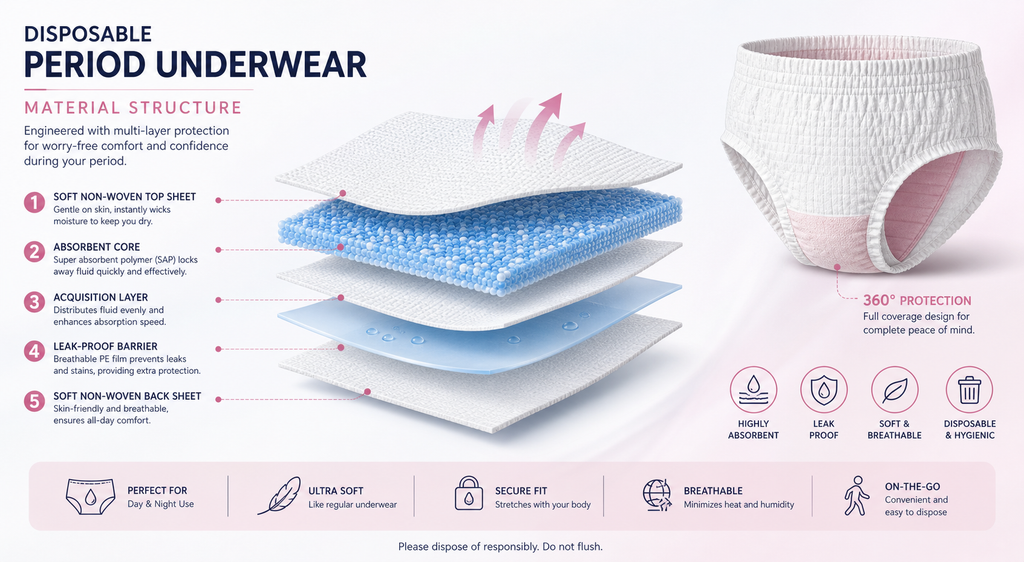
Absorbency is one of the most important performance considerations for disposable period underwear.
Unlike conventional sanitary pads, disposable period underwear includes an underwear-style structure that must combine absorbent performance with fit and coverage.
Absorbent Core Design
An absorbent core should be designed to absorb and retain liquid under relevant use conditions.
Depending on the product configuration, absorbent materials may include:
Fluff pulp
Superabsorbent polymers (SAP)
Nonwoven materials
Other absorbent components
The combination and arrangement of materials can influence:
Absorption speed
Absorption capacity
Liquid distribution
Fluid retention
Product thickness
A reliable manufacturer should be able to discuss how absorbent core design supports the intended product performance.
Leakage Protection
Leakage protection depends on more than absorption capacity.
Product structure, fit, coverage, and material selection can all influence leakage performance.
Important design considerations include:
Absorbent core placement
Leak-resistant materials
Leg opening construction
Waistband fit
Product coverage
Product dimensions
Performance Testing
When evaluating samples, buyers should request information about relevant product testing.
Depending on the product and project requirements, testing may include:
Absorption capacity evaluation
Absorption speed assessment
Liquid retention testing
Leakage performance evaluation
Product dimension checks
Material inspection
Test methods and acceptance criteria should be agreed upon according to the intended product specifications and applicable market requirements.
B2B Buyer Tip: Avoid comparing disposable period underwear products based only on advertised absorbency claims. Ask suppliers for the relevant testing methods and results.
5. Evaluate Product Comfort, Fit, and Size Options
Disposable period underwear is worn as a complete underwear-style product, making comfort and fit essential considerations.
Even a product with good absorbency may provide an unsatisfactory experience if the waistband is too tight, the leg openings are uncomfortable, or the overall size does not match the intended user.
Material Softness
The materials used in disposable period underwear should be selected with skin contact and comfort in mind.
Brands may evaluate different nonwoven materials and surface characteristics during sampling.
Waistband Design
The waistband influences how securely the product fits around the waist.
Different elastic configurations may be considered depending on product design and target consumers.
Leg Opening Fit
Leg opening dimensions and construction can affect both comfort and leakage protection.
Poorly fitted leg openings may create gaps or excessive pressure.
Size Range
Consumers have different body shapes and sizing needs.
A manufacturer should be able to discuss product dimensions and available sizing options.
For brands targeting international markets, it is important to define sizing according to the intended consumer group rather than assuming that one standard size system works everywhere.
Sample Fit Evaluation
When reviewing product samples, consider:
Waist comfort
Leg opening fit
Product coverage
Movement comfort
Overall dimensions
Consistency between samples
Fit requirements should be documented before approving mass production.
6. Review Manufacturing Hygiene and Quality Control
Disposable period underwear is an intimate hygiene product, making manufacturing hygiene and product consistency important supplier evaluation criteria.
A reliable disposable period underwear manufacturer should maintain appropriate procedures for raw material handling, production sanitation, quality inspection, and finished product management.
Raw Material Management
Ask how the manufacturer receives, stores, and inspects raw materials.
Proper material management can help reduce contamination risks and support production consistency.
Production Environment
Evaluate whether the manufacturer maintains clean and controlled production conditions appropriate for hygiene products.
Important factors may include:
Sanitation procedures
Production area management
Temperature and humidity control
Material handling procedures
Equipment cleaning and maintenance
In-Process Quality Inspection
Quality checks during production can help identify potential issues before products reach the final packaging stage.
Inspection items may include:
Product dimensions
Absorbent core placement
Material bonding
Product appearance
Packaging consistency
Finished Product Inspection
Finished product inspection may involve checking product specifications, packaging accuracy, appearance, and other agreed quality requirements.
Dailys Quality Management
At Dailys, quality and sanitation management are integrated into our manufacturing operations.
Our facilities incorporate:
Standardized sanitation management procedures
Temperature and humidity control systems
Dedicated hygienic raw material storage areas
Production quality control procedures
Finished product inspection processes
These measures support organized manufacturing and consistent product quality.
7. Verify Certifications and Market Compliance
Certifications and compliance documentation can be important when evaluating a disposable period underwear manufacturer in China.
However, buyers should understand that different certifications and documents serve different purposes.
Manufacturing and Social Responsibility Audits
Manufacturing audits and social responsibility assessments may provide information about a factory’s operating practices.
For example, BSCI-related audit documentation concerns social compliance rather than directly certifying the performance or safety of disposable period underwear.
Material Certifications
Material-related certifications may apply to specific raw materials or sourcing processes.
Their scope should be verified before making claims about finished products.
Product Compliance
Product requirements vary by destination market.
Depending on local regulations, disposable period underwear may be subject to specific requirements concerning:
Product safety
Labeling
Material restrictions
Product testing
Import documentation
Packaging information
Buyers should verify the applicable regulations in their target markets.
Dailys Compliance Support
Dailys maintains a range of certifications, registrations, audit approvals, and compliance documentation related to its manufacturing operations, materials, and products.
These include documentation associated with CE, FDA-related compliance, BSCI, OCS, FSC, and other relevant requirements.
The applicability of each document depends on its specific scope, product category, and destination market.
Our team can discuss available documentation based on your project requirements.
8. Understand MOQ, Pricing, and Production Lead Times
Before selecting a disposable period underwear wholesale supplier, buyers should understand the commercial requirements associated with their projects.
Minimum Order Quantity (MOQ)
MOQ refers to the minimum quantity required for a production order.
For disposable period underwear, MOQ may depend on:
Product size
Materials
Absorbency requirements
Product structure
Custom packaging
Manufacturing configuration
Order complexity
Products requiring extensive customization may have different MOQ requirements from established product configurations.
Manufacturing Costs
Several factors influence disposable period underwear manufacturing costs.
Materials
Nonwoven materials, absorbent components, elastic materials, and other structural elements contribute to product cost.
Absorbency
Different absorbent core configurations can affect material consumption and manufacturing requirements.
Size
Larger product dimensions may require different quantities of raw materials.
Packaging
Private label retail bags, boxes, individual packaging, and printed cartons can influence costs.
Order Quantity
Order volume can affect manufacturing efficiency and material purchasing arrangements.
Testing Requirements
Additional testing or documentation may affect overall project costs.
Production Lead Time
Manufacturing lead time depends on product specifications, sample approval, raw material availability, packaging development, order quantity, and production scheduling.
For customized products, buyers should allow time for product development and sample confirmation before mass production.
How to Request an Accurate Quote
When contacting a disposable period underwear supplier, provide:
Target market
Product specifications
Expected sizes
Absorbency requirements
Preferred materials
Order quantity
Packaging requirements
Target price range
Expected delivery schedule
Providing detailed information helps the manufacturer prepare a quotation aligned with your project.
9. Request Samples Before Placing a Bulk Order
Sampling is an essential step when evaluating a potential OEM disposable period underwear manufacturer.
Samples allow buyers to assess product specifications, performance, comfort, and packaging before confirming mass production.
What Should You Check?
Product Appearance
Check overall construction, surface finish, and visible defects.
Product Dimensions
Compare the actual product dimensions with the confirmed specifications.
Absorbency
Assess the product’s absorption performance using relevant testing methods.
Leakage Protection
Evaluate leakage performance under appropriate conditions.
Comfort and Fit
Assess waistband elasticity, leg opening fit, material softness, and coverage.
Packaging
Review packaging design, printing quality, product counts, and labeling.
Sample Development and Optimization
For ODM projects, multiple sampling rounds may be necessary.
For example, buyers may request changes to:
Absorbent core structure
Product dimensions
Waistband elasticity
Leg opening design
Material softness
Packaging artwork
Once the samples meet the agreed requirements, the final specifications should be confirmed before mass production.
Dailys Sampling Support
Supported by two R&D centers, Dailys provides product development and sampling support for customized hygiene product projects.
Our team works with customers to evaluate materials, product structures, and specifications according to their requirements.
10. Consider Private Label Packaging and Branding Support
For brands planning to launch their own menstrual care products, packaging customization is an important part of product development.
A suitable private label disposable period underwear manufacturer should understand the packaging needs of different sales channels.
Private Label Branding
Depending on the project, customization may include:
Brand logos
Packaging colors
Product names
Artwork design
Product information
Retail packaging formats
Packaging Options
Potential packaging formats include:
Printed retail bags
Packaging boxes
Outer cartons
Customized labels
Market-specific packaging artwork
The available options should be confirmed with the manufacturer.
Packaging for Different Sales Channels
Retailers may prioritize shelf presentation and clear product information.
E-commerce brands may focus on packaging dimensions, product presentation, and shipping efficiency.
Importers and distributors may require packaging adapted to local labeling and distribution requirements.
At Dailys, we support private label branding and customized packaging solutions according to customer requirements.
11. Evaluate Communication, Export Experience, and Long-Term Cooperation
A successful manufacturing partnership requires more than suitable products and competitive quotations.
Clear communication and reliable project coordination are important throughout the entire OEM/ODM process.
Communication During Product Development
Product development often involves multiple rounds of discussion covering:
Product requirements
Material selection
Sample feedback
Packaging artwork
Product testing
Order confirmation
A responsive manufacturing partner can help reduce misunderstandings and improve project coordination.
International Trade Experience
For overseas buyers, export-related support can be valuable.
Depending on the agreed service scope, this may involve:
Export documentation
Shipping arrangements
Packaging requirements
Order coordination
Communication with logistics partners
Long-Term Manufacturing Support
As your brand grows, you may need to introduce additional sizes, absorbency options, or packaging formats.
A suitable manufacturing partner should be able to discuss how it can support future product development and repeat orders.
Dailys works with international feminine care brands, importers, distributors, retailers, and e-commerce businesses, providing OEM/ODM manufacturing and project coordination support.
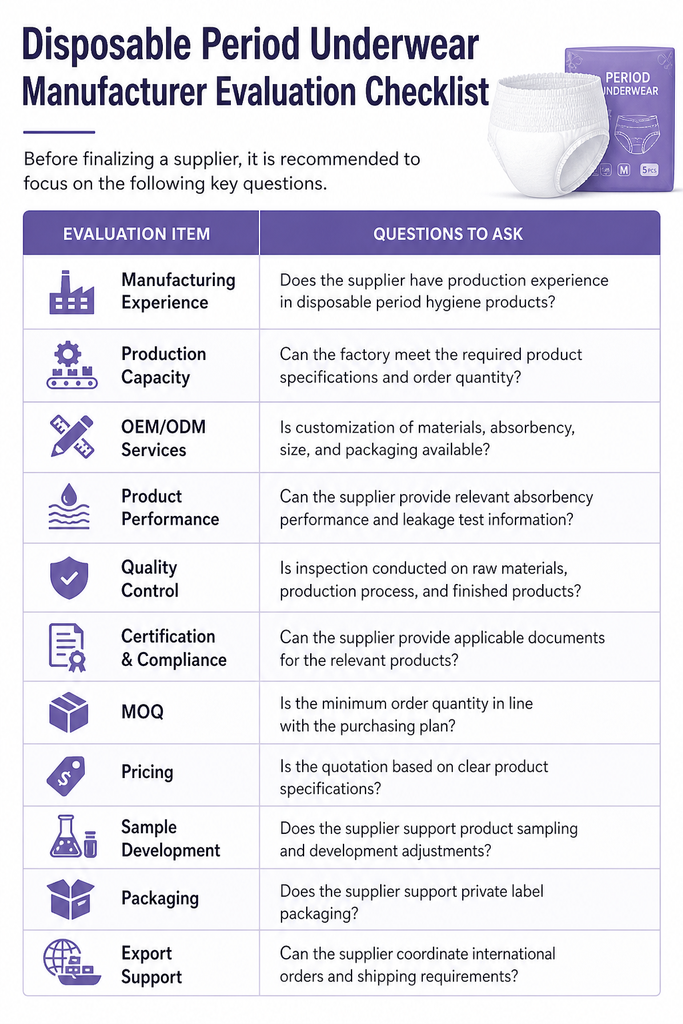
Using a consistent supplier evaluation checklist can help buyers compare manufacturers more effectively.
Why Choose Dailys as Your Disposable Period Underwear Manufacturer?
Choosing a reliable manufacturing partner is an important part of developing a successful disposable menstrual care product range.
At Changzhou Dailys Care Products Co., Ltd., we combine over 20 years of hygiene product industry experience with automated manufacturing capabilities, product development support, and OEM/ODM customization services.
Over 20 Years of Hygiene Manufacturing Experience
Dailys has extensive experience in feminine hygiene, maternal care, and personal care products.
We understand the importance of product performance, comfort, manufacturing consistency, and quality management.
35,000 m² Manufacturing Facility
Our manufacturing and office facilities cover approximately 35,000 m², supporting product development, production management, quality control, and international business operations.
20 Automated Disposable Hygiene Production Lines
Dailys operates 20 fully automatic production lines for disposable hygiene products.
These manufacturing capabilities support efficient production and consistent product processing.
Two R&D Centers
Our R&D capabilities support product development, material evaluation, sample preparation, and product optimization.
OEM/ODM Product Customization
Dailys supports customization based on customer requirements, including:
Material selection
Absorbent core structures
Absorbency levels
Product dimensions
Underwear sizes
Functional features
Private label packaging
Branding and artwork
Quality-Focused Manufacturing
Our manufacturing operations incorporate standardized sanitation management, environmental controls, raw material storage procedures, and quality inspection processes.
International B2B Customer Support
We work with:
Feminine care brands
Private label brands
Importers and distributors
Retailers and supermarket chains
E-commerce brands
Healthcare and personal care companies
From product concept and sampling to manufacturing, packaging, and shipping, Dailys supports customers throughout the OEM/ODM development process.
Looking for a Reliable Disposable Period Underwear Manufacturer in China?
Partner with Dailys to develop customized disposable menstrual underwear products for your brand.
Frequently Asked Questions About Disposable Period Underwear Manufacturing
1. What is disposable period underwear?
Disposable period underwear is a single-use menstrual hygiene product designed with an underwear-style structure and integrated absorbent materials.
It provides full-coverage menstrual protection and is intended to be disposed of after use.
2. Can disposable period underwear be customized for private label brands?
Yes. Depending on manufacturing capabilities, disposable period underwear can be customized in terms of materials, absorbency, sizes, product structure, branding, and packaging.
Dailys provides OEM/ODM customization support based on customer requirements.
3. What is the difference between disposable and washable period underwear?
Disposable period underwear is designed for single use and disposal after wearing.
Washable period underwear is made with reusable textile materials and is designed to be washed and worn again according to the manufacturer’s care instructions.
The two product categories involve different materials, manufacturing processes, and performance considerations.
4. What is the MOQ for private label disposable period underwear?
MOQ depends on factors such as product specifications, material selection, size requirements, customization level, packaging, and manufacturing arrangements.
Contact the manufacturer with your project requirements to confirm the applicable minimum order quantity.
5. How do I evaluate the quality of disposable period underwear?
Buyers should evaluate product dimensions, absorbency, leakage protection, material softness, fit, product construction, and packaging.
Relevant testing methods and acceptance criteria should be agreed upon with the manufacturer.
6. Can I customize disposable period underwear packaging with my brand logo?
Yes. Private label manufacturers may support customized packaging, including brand logos, retail bags, boxes, labels, and artwork.
Available packaging options depend on the manufacturer’s capabilities and project requirements.
7. How long does disposable period underwear manufacturing take?
Production lead times depend on product specifications, sample approval, material availability, packaging requirements, order volume, and production scheduling.
For customized OEM/ODM projects, additional time may be required for product development and sampling.
8. Does Dailys provide disposable period underwear OEM/ODM manufacturing?
Yes. Dailys provides OEM/ODM manufacturing services for disposable period underwear, including product development support, material and absorbency customization, sampling, private label packaging, and manufacturing.
Our team works with international brands, importers, distributors, and retailers to develop products according to their market requirements.
Develop Your Private Label Disposable Period Underwear with Dailys
Selecting the right disposable period underwear manufacturer requires careful evaluation of production capabilities, product customization options, quality control, and long-term cooperation potential.
For private label brands and international buyers, an experienced OEM/ODM partner can help simplify product development while supporting consistent manufacturing and customized product specifications.
With over 20 years of hygiene industry experience, automated production facilities, two R&D centers, and integrated OEM/ODM services, Dailys supports overseas customers in developing disposable menstrual care products tailored to their brands.
Whether you are launching a new private label disposable period underwear collection or expanding an existing feminine hygiene product range, our team is ready to discuss your manufacturing requirements.
Ready to Develop Your Disposable Period Underwear Brand?
Contact Dailys to explore customized materials, absorbency levels, product sizes, packaging, and OEM/ODM manufacturing solutions.
Frequently Asked Questions
How do I choose a disposable period underwear manufacturer?
Choose a manufacturer with proven production capabilities, consistent quality control, verified absorbency and leakage performance, OEM/ODM services, and export experience. Request product samples, review relevant certifications and test reports, and confirm MOQ, lead time, packaging options, and customization capabilities before placing an order.
Can manufacturers provide OEM and private label disposable period underwear?
Many disposable period underwear manufacturers offer OEM and private label services, including product specifications, absorbent core options, sizes, materials, packaging design, and branding. Buyers should confirm customization capabilities, artwork requirements, minimum order quantities, sample approval procedures, and production timelines with the manufacturer.
What is the MOQ for disposable period underwear OEM orders?
The minimum order quantity (MOQ) depends on the manufacturer's production setup, product specifications, packaging design, and customization requirements. Ask for separate MOQs for standard products and custom private label orders, and confirm whether mixed sizes or multiple SKUs can be included in one order.
How can buyers verify the quality of disposable period underwear?
Buyers should request samples and review documented test results for absorbency, leakage resistance, material safety, fit, and product durability as applicable. They should also check the manufacturer's quality control procedures, batch inspection records, traceability practices, and relevant market-specific compliance documentation before approving bulk production.