If you’re launching or expanding a feminine care brand, one of the first manufacturing decisions you’ll face is whether to choose OEM or ODM.
The two terms are often used interchangeably, but they can represent different approaches to product development, customization, cost, lead time, and intellectual property.
This distinction is particularly important for sanitary pads, period underwear, menstrual pants, and other private label period products. Some buyers already have detailed product specifications and simply need a manufacturer to turn them into commercial products. Others start with only a target market, price point, or product concept and need more development support.
Neither model is inherently better.
The right choice depends on what you already have, how differentiated you want the product to be, your budget, launch timeline, expected order volume, and target market.
This guide explains OEM feminine hygiene products and feminine care ODM from a practical B2B sourcing perspective—and what you should discuss with a manufacturer before starting your project.
What Is OEM in Feminine Care?
OEM stands for Original Equipment Manufacturer.
In a typical feminine care OEM project, the buyer usually defines more of the product requirements, while the manufacturer is responsible for turning those requirements into a manufacturable product and producing it at commercial scale.
For example, a customer developing OEM sanitary pads may specify requirements such as:
- Product length and shape
- Day or night use
- Topsheet material
- Absorbent core structure
- Target absorbency
- Thickness
- Wing design
- Individual wrapper
- Number of pads per pack
- Packaging artwork
- Brand identity
- Target market
Depending on the project, the manufacturer may then evaluate feasibility, source materials, develop samples, conduct relevant testing, optimize production parameters, and manufacture the approved specification.
OEM is generally more suitable when the buyer already has clear product requirements and wants greater control over the final specification.
What Is ODM in Feminine Care?
ODM stands for Original Design Manufacturer.
In an ODM project, the manufacturer typically contributes more of the existing product design, technical solution, or product development know-how.
For example, a buyer may approach a feminine care ODM manufacturer and say:
“We want to launch an affordable ultra-thin sanitary pad range for the European market, but we haven’t finalized the product structure.”
Instead of manufacturing from an existing customer specification, the ODM manufacturer may recommend available product structures, materials, sizes, absorbency options, packaging formats, or existing product platforms that can be adapted to the customer’s brand.
This can reduce the amount of product development required from scratch.
ODM can therefore be attractive to:
- New feminine care brands
- Importers expanding into a new category
- Distributors launching their own brands
- Retailers developing private labels
- E-commerce brands seeking faster launches
- Buyers without an internal product development team
OEM vs. ODM: What’s the Key Difference?
The simplest way to understand the difference is to ask:
“Who is bringing more of the initial product solution to the project?”
With OEM, the buyer generally brings more defined requirements and the manufacturer focuses on engineering, manufacturing, and execution.
With ODM, the manufacturer generally contributes more of the existing design, development platform, or product solution that the buyer can select and customize.
In practice, however, feminine care projects are not always purely OEM or purely ODM.
A buyer may start with an existing manufacturer platform but change the topsheet, absorbent core, dimensions, packaging, and performance requirements. Another buyer may provide its own detailed concept but depend heavily on the manufacturer’s R&D team to make it production-ready.
For this reason, when discussing a project with a feminine hygiene manufacturer, it is more useful to define exactly who is responsible for design, specifications, testing, materials, tooling, packaging, compliance, and intellectual property rather than relying only on the label “OEM” or “ODM.”
Which Offers More Customization?
OEM typically allows deeper customization when the buyer has unique specifications, although the actual degree of customization always depends on the manufacturer’s capabilities, equipment, tooling, MOQ, materials, and budget.
For sanitary pads, potential customization may include:
- Length and width
- Product shape
- Topsheet material and feel
- Acquisition layer
- Absorbent core composition
- SAP and fluff pulp configuration
- Absorbency level
- Thickness
- Wings
- Release paper
- Adhesive configuration
- Individual wrapping
- Retail packaging
- Pack count
- Carton specifications
ODM projects can also offer considerable customization, but they often begin from an existing platform.
This means the real question isn’t simply whether a supplier “supports customization.”
Ask which parts can be changed, which require new tooling or material development, and how those changes affect MOQ, price, testing, and lead time.
How Do OEM and ODM Affect Development Time?
ODM often enables a faster route to market because the project can start from an existing product platform.
A simplified ODM process might look like:
Market Requirement → Product Selection → Sample Evaluation → Customization → Packaging → Approval → Mass Production
A highly customized OEM project may involve:
Product Brief → Technical Evaluation → Material Selection → Prototype Development → Testing → Optimization → Sample Approval → Packaging Development → Pre-Production Verification → Mass Production
However, “ODM is faster” should not be treated as an absolute rule.
A customized ODM project with new packaging, materials, or performance requirements may still take considerable time. A well-defined OEM project may progress quickly if specifications are technically mature.
Therefore, ask for a project-specific timeline rather than relying on generic lead-time promises.
What About MOQ and Cost?
MOQ is a major consideration for private label period products, but there is no universal rule that OEM always has a higher MOQ than ODM.
MOQ can be influenced by:
- Production line requirements
- Raw material MOQ
- Customized material MOQ
- Printing MOQ
- Individual wrapper MOQ
- Retail packaging MOQ
- Tooling requirements
- Production efficiency
- Product specifications
Existing ODM products may sometimes support more accessible starting quantities because the manufacturer already has suitable materials and established production parameters.
Highly customized OEM sanitary pads may require higher initial volumes if special materials, printing, tooling, or packaging are involved.
Buyers should therefore ask for the MOQ at multiple levels:
Product MOQ → Packaging MOQ → Material MOQ → Printing MOQ
This can prevent unexpected costs later in development.
Why Testing Matters in Both OEM and ODM
Whether you choose OEM or ODM, testing remains an important part of feminine care product development.
A product should not be selected purely because it looks or feels good.
For sanitary pads, depending on the product and applicable methods, testing may evaluate parameters such as:
- Absorption capacity
- Absorption speed
- Rewet performance
- Fluid distribution
- Weight and dimensions
- Material characteristics
- Adhesive performance
- Structural integrity
Testing becomes particularly useful when comparing different product structures.
For example, if two sanitary pad samples use different absorbent core configurations, objective test data can help determine whether differences in thickness or materials translate into meaningful performance differences.
This is why in-house testing capabilities can be valuable when selecting an OEM or ODM partner.
Don’t Forget Quality Control in Mass Production
A successful prototype is only the beginning.
The real challenge for a manufacturer is reproducing the approved specification consistently across thousands or millions of units.
For both feminine care OEM and ODM projects, buyers should examine how the manufacturer manages:
Raw Material Inspection → Production Monitoring → In-Process Inspection → Finished Product Testing → Packaging Inspection → Pre-Shipment Verification
It is also important to define what the “approved sample” actually represents.
Whenever possible, key specifications should be documented so that mass-production quality can be evaluated using measurable criteria—not only subjective comparison.
Who Owns the Product Design?
This is one of the most important questions in OEM/ODM cooperation—and one that should be discussed before development begins.
Do not assume that choosing OEM automatically means the buyer owns everything, or that choosing ODM means the manufacturer owns everything.
Ownership depends on contracts and the actual development arrangement.
Before investing in product development, clarify ownership and usage rights for:
- Product designs
- Custom structures
- Tooling and molds
- Packaging artwork
- Brand assets
- Technical specifications
- Custom-developed materials
- Test data where relevant
Buyers developing genuinely proprietary products should consider appropriate confidentiality and intellectual property agreements before sharing sensitive technical information.
Which Model Is Better for Private Label Period Products?
For many private-label projects, the choice depends on business stage.
ODM may be more suitable when you:
- Want a faster market launch
- Do not have a complete technical specification
- Prefer to start from an existing product platform
- Want to reduce initial development complexity
- Are testing a new market or product category
OEM may be more suitable when you:
- Have clearly defined product specifications
- Need deeper customization
- Want stronger product differentiation
- Have specific material or performance requirements
- Are building a long-term proprietary product line
Many established brands use both approaches.
They may launch certain SKUs from mature ODM platforms while investing in customized OEM development for strategic or premium products.
Questions to Ask an OEM/ODM Feminine Care Manufacturer
Before selecting a manufacturing partner, B2B buyers should ask:
- Which feminine care products do you manufacture in-house?
- What parts of the product can be customized?
- Which materials are available?
- What are the product and packaging MOQs?
- Do you have in-house R&D capabilities?
- What testing can be conducted in-house?
- How do you control quality during mass production?
- How many production lines do you operate?
- What is the typical sampling process?
- What factors affect lead time?
- Can you support customized packaging?
- What compliance documentation is available for my target market?
- How are product specifications and approved samples controlled?
- How are intellectual property and confidentiality handled?
- Can production be scaled as our business grows?
The quality of the manufacturer’s answers often tells you as much as the quotation.
How Dailys Supports OEM and ODM Feminine Care Projects
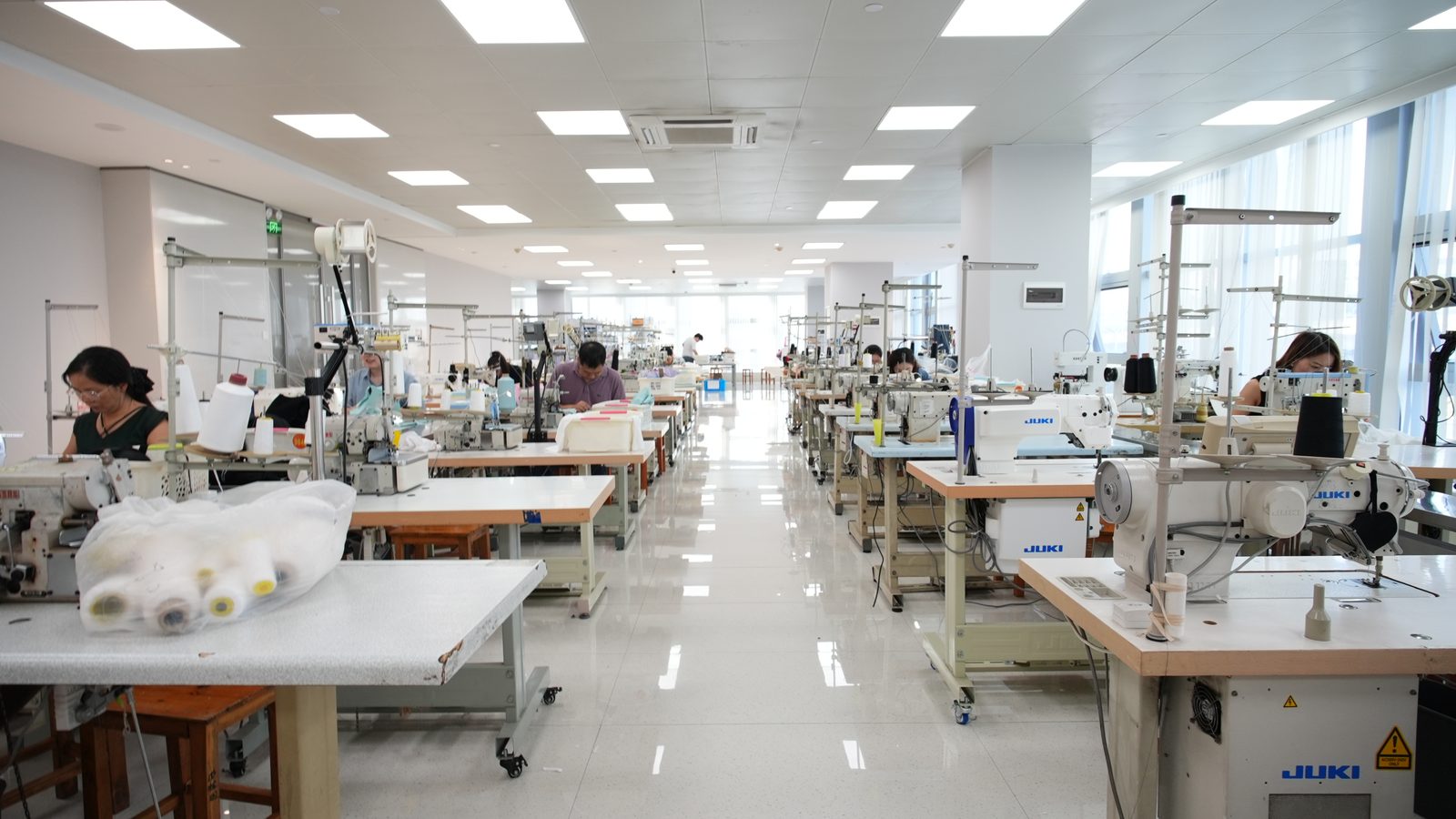
For an OEM/ODM manufacturer, production equipment is only one part of the development process.
The ability to connect R&D, testing, manufacturing, quality control, and international project support is particularly important when products require customization.
With over 20 years of industry experience, Dailys has developed an integrated manufacturing system for feminine, maternal, and personal care products.
Our capabilities include:
- 35,000 m² medical-standard production facility and office area
- 20 fully automatic disposable hygiene product production lines
- 15 fully automatic textile product production lines
- 2 R&D centers
- 2 specialized in-house testing centers for disposable hygiene and textile products
- Product development and sampling support
- Material and specification customization
- Quality control
- Private-label packaging support
- Professional international trade support
For an ODM-style project, customers can discuss target markets, product positioning, desired performance, packaging, and price range with our team before evaluating suitable product solutions.
For deeper OEM projects, R&D, testing, and manufacturing teams can work together on material selection, prototypes, performance evaluation, optimization, and mass-production preparation.
The appropriate development path depends on the product—not simply whether the project is labeled OEM or ODM.
A Simple OEM vs. ODM Decision Checklist
Consider OEM if:
- Your product specification is already clearly defined
- Differentiation is important to your brand
- You need specific materials or performance
- You are prepared for a potentially longer development process
- You want more control over product specifications
Consider ODM if:
- Speed to market is a priority
- You need development support
- You are open to existing product platforms
- You want to test a new category
- You prefer a simpler initial development process
Consider a hybrid approach if:
- You like an existing product but want meaningful modifications
- You want to launch quickly now and develop deeper customization later
- Different SKUs require different levels of differentiation
Final Thoughts
The difference between OEM and ODM feminine care products is not simply about who puts a logo on the packaging.
It is about how a product is developed, who contributes the technical solution, how much customization is required, and how development responsibilities are shared between the buyer and manufacturer.
ODM can provide a more efficient path when a brand wants to build on an existing product platform.
OEM can offer greater control when a buyer has specific requirements and seeks deeper differentiation.
But for B2B buyers, the manufacturer’s underlying capabilities matter more than the terminology.
Look for a partner that can support product development with R&D, testing, quality control, reliable manufacturing, supply chain management, and clear communication.
The best question is not:
“Do you offer OEM or ODM?”
It is:
“How can you turn our product requirements into a consistent, scalable, market-ready product?”
Planning an OEM or ODM Feminine Care Project?
Whether you are developing OEM sanitary pads, period underwear, or other private label period products, Dailys can support your project from concept and material selection to sampling, testing, manufacturing, quality control, and customized packaging.
Talk to our team about your product idea, target market, expected order volume, and performance requirements.